


COMMUNITY TRAVEL STORIES
FOUNDER'S TRAVEL ADVENTURES
HELPFUL EXTRAS
“This Is Not Possible.” My African Photo Even the Guide Couldn’t Explain

Introduction: A New Adventure Begins
I first travelled to Africa when I was fifteen. It was one of those trips that changes the way you see the world. The landscapes feel older, the wildlife feels closer, and somehow everything seems to operate on a different rhythm. I wrote about that first safari in Stalked by an African Predator – My Unforgettable African Safari Adventure.
This trip was different. It wasn’t all about predators or dramatic encounters. Much of our time was spent working alongside local communities, learning about conservation, and exploring parts of Kenya that felt completely removed from the life I knew back in England.
One moment from that journey has stayed with me more than anything else. Late one evening, at the end of a long and dusty day in the bush, I took a photograph of the moon. What appeared in that photo was something I still cannot fully explain.

Passion for Photography and Overcoming Challenges
If you’ve read my previous post, you’ll know that my obsession with the lens started on that first safari. I grew up on David Attenborough and the wildlife photography of Frans Lanting. For me, photography was an escape hatch, a way to look beyond the world I was stuck in and embrace a world that felt “unseen” by everyone else.
Back at school, things were different. As a dyslexic, I found that if your ideas didn't fit neatly into a specific “marking scheme,” they didn’t count. It was exhausting work with no guarantee of a good result. I wanted to do an A-Level in Photography, but the school was initially dismissive. They wanted paintings and pottery, and photography was seen as a lesser craft, almost like a dirty secret that didn’t fit their academic ideals. It was tucked away out of sight from the main art department, mostly left to the small group of students willing to take it on as an extra-curricular.
Eventually we reached a compromise: I could do the AS-Level, only in my own time. I paid for that “A” grade with my social life. For two years I balanced, lessons, cross-country running with long hours in the darkroom, all while dealing with the intense irritability and mood swings of Roaccutane. I was a spotty, frustrated teenager, isolated by my own choice to pursue a subject the school barely valued. But I had set my mind to it. I was determined to prove I could excel in something that didn’t force my thoughts through the same narrow structure as an essay.
Note: If you're interested in how I navigated those challenges, I've written more about overcoming dyslexia in the workplace [here].

A Trip with Purpose
Going on a trip where you swim in the ocean identifying fish as part of conservation feels incredibly privileged. It was educational, sure, but what struck me more was the micro impact of it. When the seas change, it isn’t just a scientific problem; it affects people who rely on that water for their lives.
We also spent time helping build a school and sanitation facilities for the village. It was hard work, hot, dusty, and very real. For someone who burns easily, I was constantly applying suncream and then sweating it off almost immediately while carrying cement or digging into the red earth to lay pipes for the toilets. Most of the time, the work was far from glamorous. I have a photo of us just clearing long, dry grass hours spent hacking away at the vegetation just to prepare the local area. There was nothing cinematic about building a toilet. It was practical work that needed doing, and sanitation matters more than most people realise.

One of the stranger tasks was making paper from elephant dung so local children could draw and write. It sounds ridiculous at first, but it works. It also makes you realise how many everyday things we take for granted. I grew up with hot water and taps that always worked. You rarely think about those things until you see a place where the basics aren’t guaranteed.
What stayed with me most, though, was the people. I was always struck by how people who have so much less in life can appear so much happier and more carefree than we are. Honestly, there’s an element of me that envied that approach to life. I learned that everyone really does smile in the same language. You can see it when a smile is genuine because it reaches the eyes. Laughter is unanimous.
Tsavo: The Land of Historical Intrigue
Tsavo carries a certain weight. Part of that comes from its history, known for the infamous man-eating lions that attacked railway workers in the late nineteenth century. Even though those events happened long ago, the story still lingers in the background. It’s a reminder that nature isn’t a controlled environment.
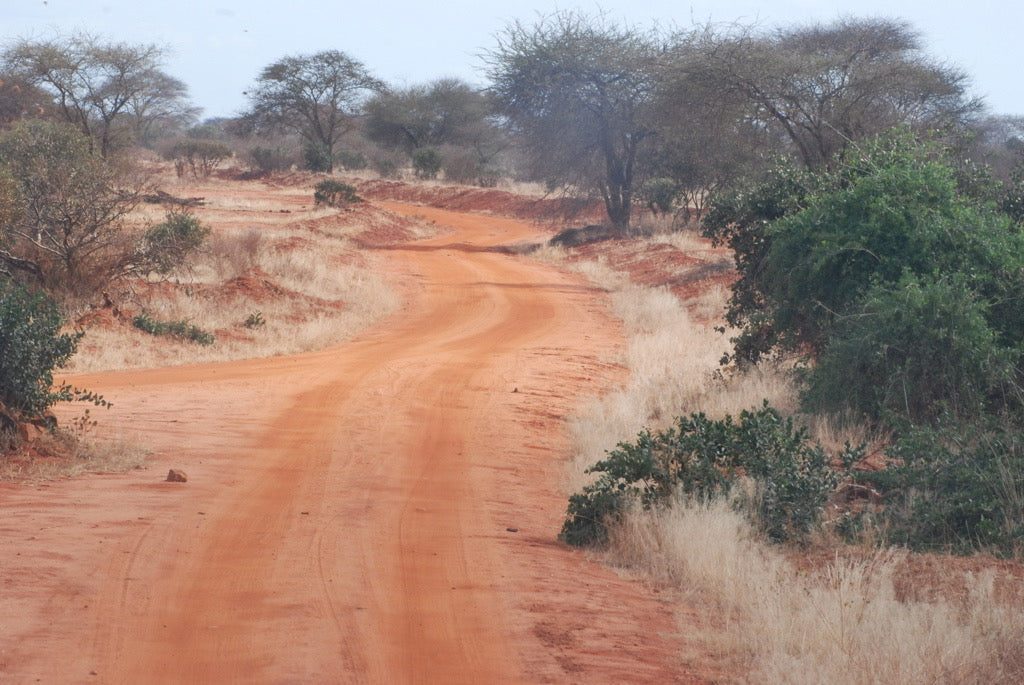
The red dirt gets everywhere: on your shoes, on the vehicle, in the air. Yet there’s something strangely beautiful about it. The colour hints at the region’s volcanic history and makes the land feel ancient, as though the ground itself has been shaped by forces far older than anything around you. You’re not just driving through a park; you’re moving through something much older.

A Moonlit Mystery
As the day drew to an inescapable close, we were dusty, tired, and dirty, but somehow completely alive. The engine rumbled beneath us, kicking dust into the darkness where you couldn’t see it, only feel it slowly settling onto your sun-creamed face.
Everyone was chatting away in good spirits as the truck bounced along those “lovely awful” roads. I was doing what I usually did when things slowed down, playing with my camera. I had it resting on a beanbag, experimenting with settings in the dark. I wasn’t even trying to capture a perfect photo; I was just trying to understand how light behaved at night.
The moon appeared as blurred streaks of white across the sky, almost like someone had taken a white paintbrush and dragged it across a dark canvas. I must have taken ten of these in quick succession. No one was paying attention to me, and I was only half-watching the screen myself, trying to balance being present with everyone else while quietly obsessing over camera settings.
Then suddenly something changed.

The Unexpected Discovery
We were still on the same road. The moon was in the same place. I lifted the camera and took another photo. When it appeared on the screen, I stopped. At first I assumed something had gone wrong with the exposure. I took another photo immediately. The next image went straight back to the familiar blurred streak of moonlight.
I went back to the previous image. The difference wasn’t subtle. It wasn’t just a change of colour or exposure. There was a figure in the sky. When I showed the people next to me, and then our guide, the mood in the truck shifted instantly. It was like someone had suddenly told a ghost story.
Our guide stared at the image. “No, no, no,” he said quietly. “This is not possible.”
What appeared in the photograph was unmistakable: a face. A man with a beard, eyes, and a mouth. And separate from the face, clear as anything, was a thumb. A thumbs-up.
Some people thought it might be a good omen. Others weren’t so sure. I’ve spent a long time thinking about whether to share that photograph at all because experiences like that feel strangely personal. It’s a bit like reading tea leaves; you start to see the patterns you want to see. Maybe it was a sign. Maybe it wasn’t. Maybe it was just a trick of light.

Reflection
To this day, I still don’t understand what caused it. And honestly, that doesn’t bother me. What stayed with me wasn’t the logic, but the feeling. That sudden sense of awe you get as a child when you see something for the first time, a feeling that becomes harder and harder to find the older we get.
I’ve always been drawn to the unseen, curious about the stories that hide just out of view. It’s one of the reasons I travel in the first place: to explore the unseen corners of the world that most people pass by. But for one brief moment, in the back of a bouncing truck on a “lovely awful” road in Kenya, the unseen didn’t stay hidden.
It looked straight back at me.
Leaping Fox. Exploring the unseen.

About Author
-


British adventure photographer James Evans is driven by a passion for uncovering hidden beauty. His journey with Leaping Fox reflects this spirit, inviting others to explore their own unique perspectives and "Explore the Unseen." Learn more about the vision behind Leaping Fox and the stories that inspire it.
learn more