


COMMUNITY TRAVEL STORIES
FOUNDER'S TRAVEL ADVENTURES
HELPFUL EXTRAS
How the Grand Canyon Broke Me in a Single Day
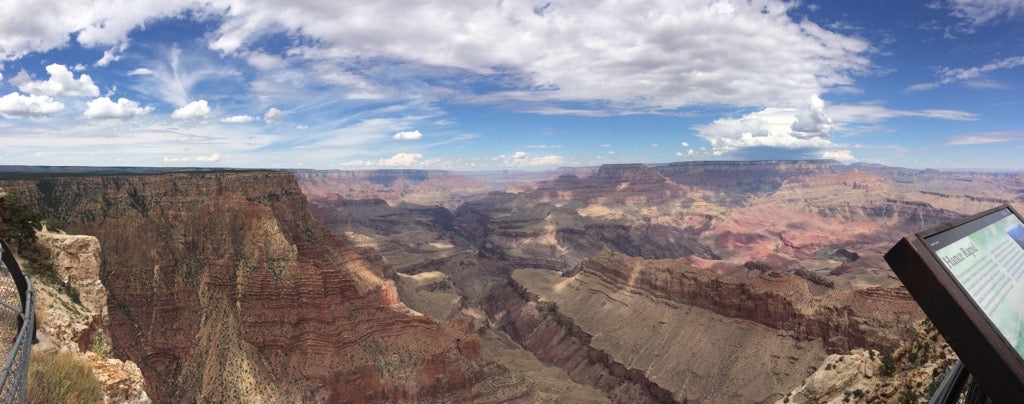

The Grand Canyon is difficult to understand.
Standing on the rim of the Grand Canyon, your brain flat-out refuses to believe what your eyes are seeing. It’s too vast to be "scenery." It’s like looking at the Earth from an airplane window, you know the ground is far away, and your mind can't quite bridge the gap between "visible" and "reachable."

At twenty-one, travelling across America in a campervan with friends, we decided looking at it wasn’t enough.
We wanted to walk into it.
More specifically, we thought it would be a terrific idea to hike to the bottom of the Grand Canyon and back up again in a single day.
The National Park Service strongly advises against doing exactly this. There are warning signs everywhere, some of them featuring a rather distressed-looking hiker. The round trip is around 17 miles with roughly 5,000 feet of elevation change each way. Temperatures at the bottom regularly exceed 40°C, and the climb back out is long, steep, and exposed.
But we were young, reasonably fit, and full of the quiet confidence that comes from not yet knowing what you don’t know.
The descent was fantastic.

Gravity is a kind friend on the way down. The trail winds through layers of rock that tell millions of years of geological history, each turn revealing another vast wall of canyon. The air grew hotter as we dropped deeper, but the walking felt easy and our spirits were high.
If anything, we probably felt a little too confident.
I remember sweating heavily on the way down. I kept drinking water to compensate, assuming hydration was the key to staying safe in the heat. At the time it felt sensible.
Looking back, that was probably where things started to go wrong.

By the time we reached the bottom of the canyon, the heat was intense. We rested briefly near a small station where the only food available was peanuts. We sat in the furnace-like warmth of the canyon floor, ate our salty snacks, and looked up.
The rim was now a thin line high above us.
Then we started the climb back.
Two of my friends set off quickly. There was some competitive bravado about beating the recommended time for the hike. One of my friends stayed with me as we began the long ascent.
At first I just felt slightly off.
Not tired in the usual sense. Not even particularly hot. Just weaker than I expected.
I drank more water.
But strangely, the more water I drank, the weaker I felt.

The climb steepened. The heat became relentless. Shade disappeared almost entirely, and every small sliver of rock shadow became a temporary goal. I would push myself toward the next patch of shade, stop briefly, and then continue.
Slowly, my pace began to disintegrate. My legs weren't just tired; they were uncooperative, as if the connection between my brain and my muscles was fraying. It wasn’t the burning exhaustion of a long run; it was a hollow, unfamiliar weakness that felt like my internal battery had been replaced with a handful of sand. I felt weak.
One of my friends noticed and offered me some of his banana. I ate it gratefully, hoping the energy would help.
It didn’t.
Soon I was moving painfully slowly, one step at a time. The canyon walls seemed endless. Every time I looked up, the rim still appeared impossibly far away.
Eventually I found myself leaning slightly on my friend as we climbed.
It was deeply embarrassing. We were all reasonably fit. I might have been the least fit of the group, but not dramatically so. I couldn’t understand why I was the one struggling while the others had surged ahead.
But my friend stayed with me.
He kept encouraging me forward, calmly and steadily. Looking back, it’s not surprising he later joined the army. The quiet support and camaraderie he showed that day were exactly the kind of qualities that belong there.
Step by step we continued upward.

At one point I genuinely wondered if I might collapse. I didn’t think I was in real danger, but I could feel that something in my body wasn’t working properly.
The strange part was that drinking more water seemed to make it worse.
I would only understand later what was probably happening.
By sweating heavily all day and replacing the fluid with water alone, I had likely diluted the sodium levels in my body. Without enough electrolytes, the muscles struggle to function properly. We actually had rehydration salts with us — but in the chaos of packing the campervan they had been left behind in the car.
It was a simple mistake.
Eventually, after what felt like an eternity of slow, grinding progress, the trail levelled out and the canyon walls fell away.
We had reached the rim again.
Back on level ground I was exhausted, weak, and clearly overheated. But after some proper food, shade, and time to recover, I slowly began to feel normal again.
The warning signs around the canyon suddenly made perfect sense.
The Grand Canyon is deceptive. The descent feels easy, the scale doesn’t seem real, and by the time you realise how far you’ve gone, the sun is already high and the hardest part of the journey is still ahead.
The park authorities are right to warn people not to attempt the hike in a single day.
But I’m also strangely grateful that we did.
Because ever since that day, whenever I head out on a long hike, I am far more prepared. I carry proper food, I carry electrolytes, and I carry a healthy respect for heat and distance.
You learn a lot from the close calls.
The Grand Canyon is a master of deception. It invites you down with gravity and punishes you on the climb with physics you didn't see coming. I’m lucky that the only thing I truly left behind at the bottom of that canyon was my ego.
Leaping Fox. Exploring the unseen.

About Author
-


British adventure photographer James Evans is driven by a passion for uncovering hidden beauty. His journey with Leaping Fox reflects this spirit, inviting others to explore their own unique perspectives and "Explore the Unseen." Learn more about the vision behind Leaping Fox and the stories that inspire it.
learn more