


COMMUNITY TRAVEL STORIES
FOUNDER'S TRAVEL ADVENTURES
HELPFUL EXTRAS
Corcovado: 3% of the World’s Biodiversity
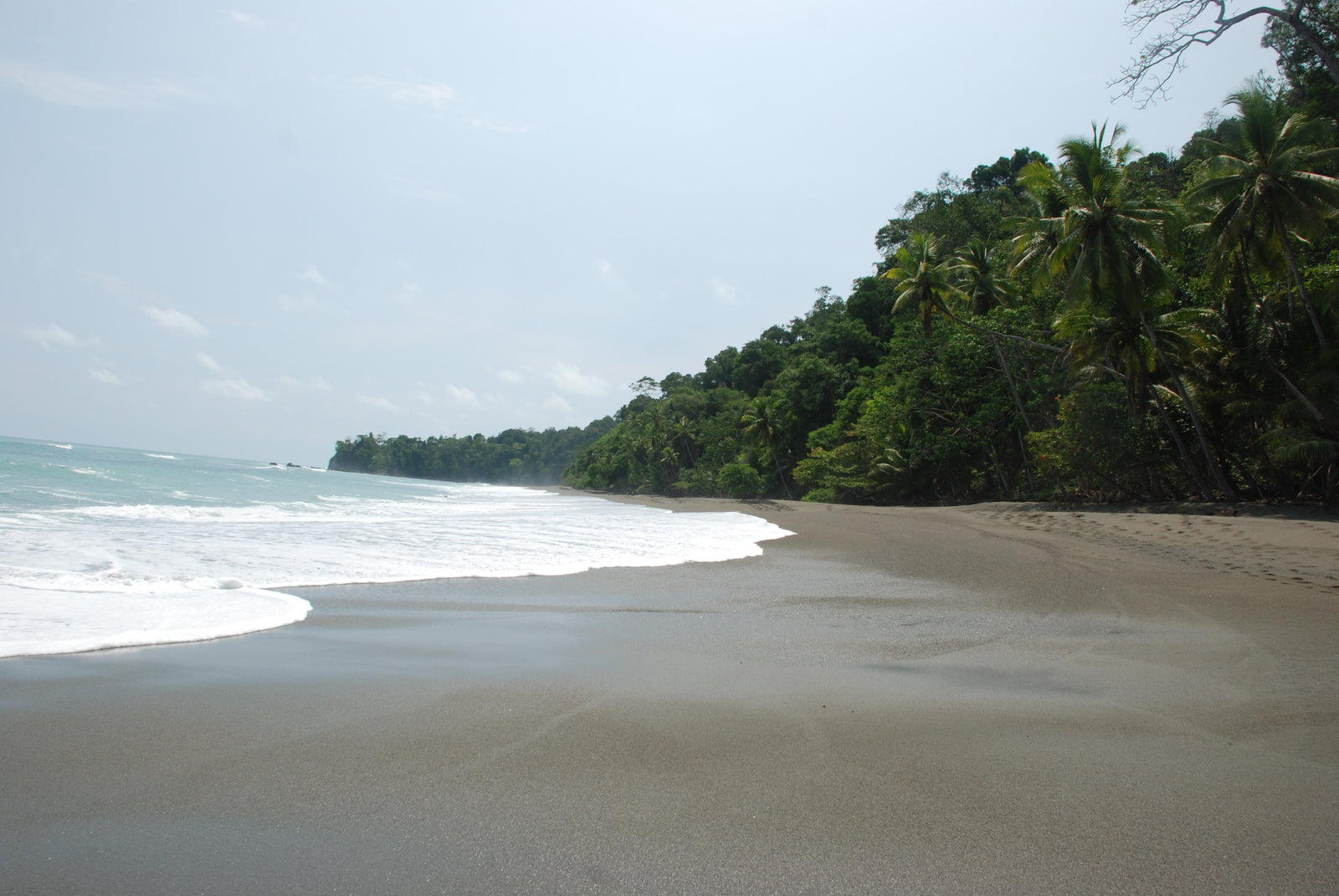

Costa Rica is one of the most spectacularly biodiverse playgrounds on the planet. Without question it is one of the greatest places I have ever been.
But I’m not talking about the places where everyone goes.
I’m talking about one very specific place.
Corcovado National Park.
Most people reach it by boat. Some arrive by tiny private plane, landing on a narrow airstrip carved out of the jungle. Both get you there quickly.
But there is another way.
I like to think of it as the entrance exam.
We flew south to Puerto Jiménez.

Bounced along the coast in a bone-rattling jeep for hours, and then began the real journey: a fifteen-mile hike through the rainforest to the Sirena Ranger Station.
It was hot. It was humid. It was relentless, and very sweaty.
The trail shifted constantly between dense jungle and exposed beach. Under the canopy the air was thick and unmoving, the forest pressing in on every side. On the sand there was no cover at all, just the sun beating down while every step sank your boots deeper into the grains pulling your feet down with every step.
It was a journey that felt designed to test you before it rewarded you. It tested us. But the reward was worth it.

Costa Rica holds roughly 5% of the world’s biodiversity, with the Corcovado National Park alone accounting for nearly 3%. While places like the Amazon or Borneo are far larger, few places on Earth contain so much life packed into such a small area. The forest hums with it. Every rustle in the leaves feels like it might be something watching you back.
Anyone that has been on any sort of wildlife Safari will know, the rainforest teaches you something very quickly.
Patience matters.
Most groups push forward as if the ranger station is a finish line. They walk fast, talk loudly, and chase the idea of seeing wildlife. I find this infuriating, while I respect their choice I want to absorb, listen, hear and take it all in.
So we did the opposite.
We hung back. Against most peoples assumptions, being first was not the goal.
When a group passes through, the forest goes quiet. The animals disappear. If you wait if you sit still long enough the world begins to emerge again.

That is where you really begin to explore the unseen moments the rainforest has to offer.
At one point we stopped just off the trail and sat in silence while a troop of squirrel monkeys descended through the canopy above us. They dropped lower and lower through the branches, feeding on figs and fruit, completely unconcerned by our presence.
There was no crowd.
No noise.
Just us, the guide, and a small world unfolding around us. Being able to watch and observe, was breathtaking.

Our guide knew the forest like the back of his hand. He a complicated past with the rainforest and now a guide he had become one of the rainforest’s fiercest protectors. At one point he decided to test my resolve.
He suggested I try eating a termite.

Naturally, I assumed he was joking. So I made a deal: I would try one if he did it first. Just to make sure he wasn't having me on, or that if it tasted horrible at least he was in on the joke as well.
To my slight surprise, he popped one straight into his mouth without hesitation.
At that point, as an honour-bound gentleman, I had no choice. I proposed the deal, who would I be if I didn't partake and give it a go.
The verdict?
It tasted, unsurprisingly, like wood. Funny that. Didn't taste of much on its own.
The hike itself continued to push us. To protect the ecosystem, the park authorities are strict about what enters the forest. Food is limited and everything you bring including any water bottles in must leave with you. It’s part of the delicate balance Costa Rica has struck between tourism and preservation.
We were walking along, eyes peeled, looking through the trees hoping to grab a glimpse of something magical. I'd told him I wanted to see a Jaguar. I knew the odds were pretty slim, that doesn't take away your hope though.
Then, without warning, our guide stopped.
Dead still.
Crossing the path ahead of us was a phantom.

A big cat. Powerful, sleek, and more graceful than any Jaguar.
It possessed the nonchalant confidence of an apex predator that knows it doesn’t just live in the forest; it owns it.
For a heartbeat, the jungle held its breath. There is a strange physics to moments like that: time doesn't just slow down; it compresses until the only thing that exists is you and the animal.
The guide and I exchanged a look and understood each other instantly. He knew I was a photographer. He knew this was a once-in-a-lifetime sighting.
I handed my rucksack to my partner and quietly followed him.
Behind us my partner watched with a mixture of confusion and resignation, already aware that there was absolutely no chance I was letting this moment pass.
We kept a respectful distance and moved slowly along the trail. This big beast walked parallel through the trees. It showed no interest in us whatsoever. No tension. No aggression.
Just quiet confidence.
I wanted the photograph and yet I was also happy to just observe. I could see the muscles shifting under its coat as it moved through the dappled light.
But the rainforest was dark, my pulse was racing, and my camera settings could not keep up with the moment. In the end I captured little more than a blurry image of a tail disappearing into the brush.

The photograph didn’t matter.
For a few minutes we had shared the same space as one of the forest’s rarest predators, and that was enough. Seeing a Puma in the wild was one of the best wildlife encounters I'd ever had and at such a close distance.
Eventually we reached the Sirena Ranger Station where we spent two days exploring deeper into the park.
If you enjoy luxury travel, Corcovado is not for you.
This is not glamping.
The beds are basic mats under mosquito nets. Electricity is scarce. At night the howler monkeys begin their chorus, sounding less like primates and more like demons echoing through the jungle.
And the mosquitoes?
They loved me. They always love me. It is one of the few definite realities I know and come to expect when I go traveling that I can give back to the natural world by letting those infernal mosquitoes feast on me. Begrudgingly Yes.
Apparently people with higher metabolisms produce more carbon dioxide, which mosquitoes use to locate their targets. Whether that’s true or not, my body must have been broadcasting a signal flare.
At one point, I counted over a hundred bites on a single leg. No DEET could deter them; no layers could stop them. They didn't just bite me. They hunted me.
I felt in more danger of being consumed by the insect population than I did by the Puma minding its own business.
It turns out my body wasn't just a target; it was a beacon, broadcasting a "Free Buffet" signal flare to every winged parasite in the Osa Peninsula.
It's all part of the experience, it's certainly very memorable.
We saw tapirs wandering through the forest, scarlet macaws flashing through the sky, giant moths clinging to tree trunks, brightly coloured caterpillars, wild boar, and even the sun-bleached bones of an old whale lying on the shore.

We crossed rivers, navigated hanging bridges, and woke before dawn each day to squeeze every possible moment from the park.
Eventually we left the way many people do. I would have walked back, the way we came in, but as boring as that sounds the logistics didn't work.
So we left By boat.
Exhausted.
Dirty.
And completely exhilarated.
Corcovado is raw and wild. The rainforest will wear you down in every way it can. It will soak you, bite you, burn you, and test your patience.
But in return it will give you moments that cannot be manufactured anywhere else.
If you ever travel to Costa Rica, find your way here.
Not the easy way, if you can help it.
Take the long road in. Explore the unseen paths that others never venture down. We saw more on that grueling fifteen-mile hike than we did in the three days spent exploring from the station itself.
The rainforest is a jealous guardian of its secrets.
The most extraordinary moments reveal themselves only to those willing to pay the entrance exam in sweat and miles.
Leaping Fox. Exploring the unseen.

About Author
-


British adventure photographer James Evans is driven by a passion for uncovering hidden beauty. His journey with Leaping Fox reflects this spirit, inviting others to explore their own unique perspectives and "Explore the Unseen." Learn more about the vision behind Leaping Fox and the stories that inspire it.
learn more